
Alban S. Emery & A Century of Saint John Cabinetmaking
Our 2026 Spring Auction includes a group of sixteen pieces by or attributed to Alban Schofield Emery (1893–1990) and his apprentice Peter Claessen — the last full generation of Saint John master cabinetmakers in a tradition stretching back to the early nineteenth century. Several pieces in the group retain Emery's original paper labels or stencilled marks; the remainder are attributed on the basis of construction, vocabulary, and consultation with a recognised authority on the Emery–Claessen tradition.
Taken together they offer an unusual opportunity to acquire from a single workshop whose body of work, though produced into the late twentieth century, belongs to a long-standing Saint John cabinetmaking lineage.
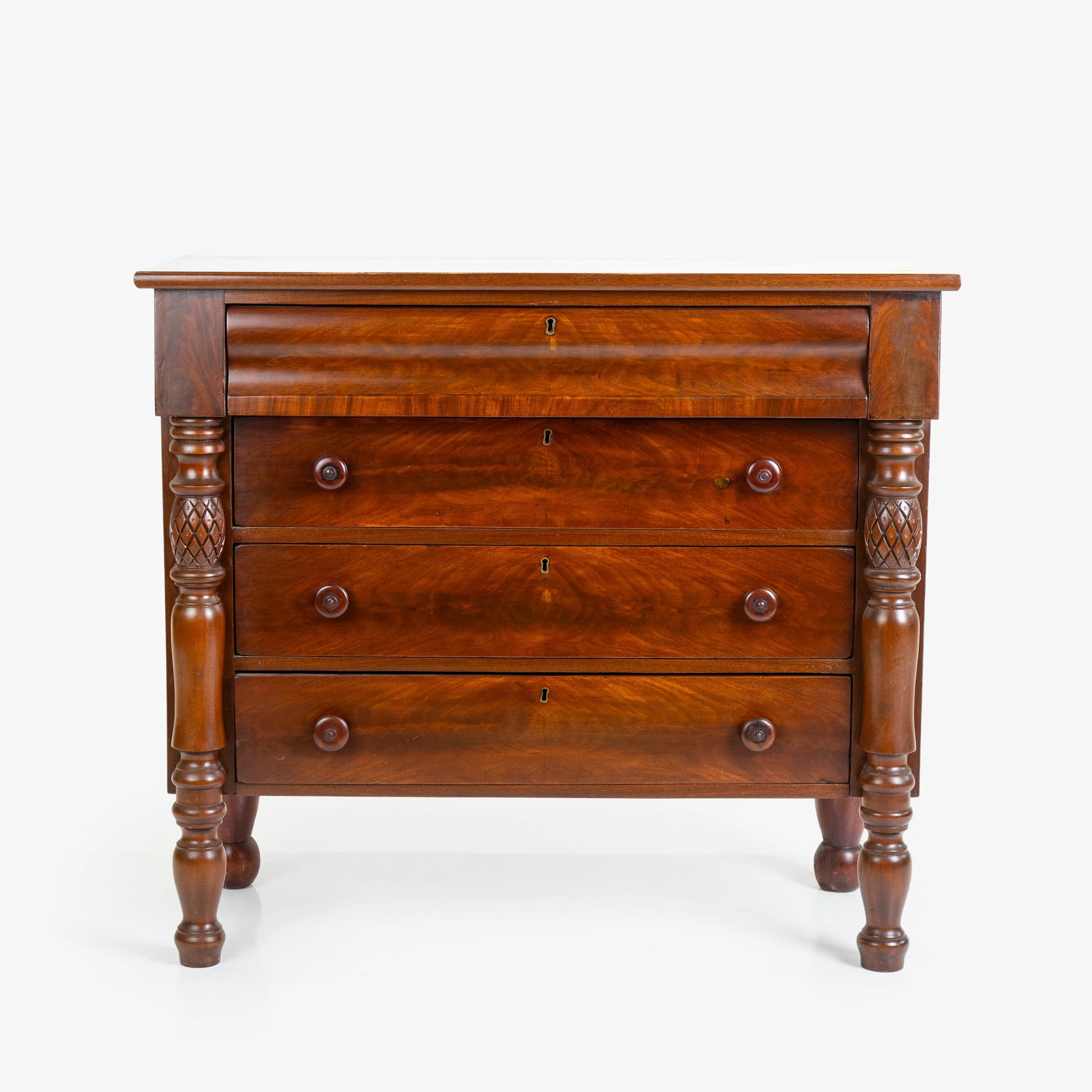
Lot 187: A Mahogany Pillow-Front Chest of Drawers in the Late Classical Taste, Attributed to Alban Emery, Saint John, New Brunswick
A Saint John tradition
Saint John was, for most of the nineteenth century, a serious furniture-making city. Its position as a busy timber and shipping port gave its workshops ready access to mahogany from the West Indies and a clientele (merchants, shipowners, military officers, clergy) willing to commission serious pieces. The defining figure of that early period was Thomas Nisbet, a Scottish-trained cabinetmaker who was active in Saint John between 1812 and 1848. Huia Ryder, in her foundational Antique Furniture by New Brunswick Craftsmen, calls him "the Duncan Phyfe of New Brunswick." Nisbet's Regency sideboards, card tables, and sofas — with their spiral-twisted columns, lion's-paw feet, and acanthus carving — are equal to anything produced on the continent during that period. His contemporary Alexander Lawrence worked in a parallel vocabulary (the labelled c. 1825 sofa now in the New Brunswick Museum is the principal documentary record of Lawrence's work)
Nisbet and Lawrence trained a generation; that generation trained the next. Alfred and Albert J. Lordly opened a workshop on Charlotte Street in 1855. The Howes — John D. (b. 1841) and his brother Jonas (b. 1844) — were producing carved furniture in Saint John from the 1860s. (John D. Howe conducted his training under Albert J. Lordly.)
The Great Saint John Fire occurred in 1877, which destroyed almost the whole business district of Saint John and forced the retirement of, among others, James B. Emery, the cabinetmaker and father of Alban Emery. [A side note regarding the fire: our auction house is in the Palatine Building on Prince William Street — one of the buildings that was (re-)built between 1877 and 1881.]
Apprentice & Master
Alban Emery was born in 1893 into a family of furniture makers. (His father's water-powered lathe — the one that survived the fire and the decades after it — was still turning in Alban's Water Street shop when Ryder visited him in the 1960s.) Emery began his apprenticeship in 1911 with John D. Howe, one of the most accomplished Saint John firms, and remained there roughly a decade.
Howe himself, as we mentioned above, had trained under Albert J. Lordly; the line from Nisbet and Lawrence, through Lordly and Howe, to Emery is direct and unbroken.
Emery’s shop traded under several names — Emery and Nordby from 1916, Emerys Ltd. from 1928 — before settling, in 1948, as Emery's Cabinet Shop. The mid-century label most frequently encountered reads simply Emery / St. John, N.B. / Cabinet and Upholstery Works / Custom-Made Furniture.
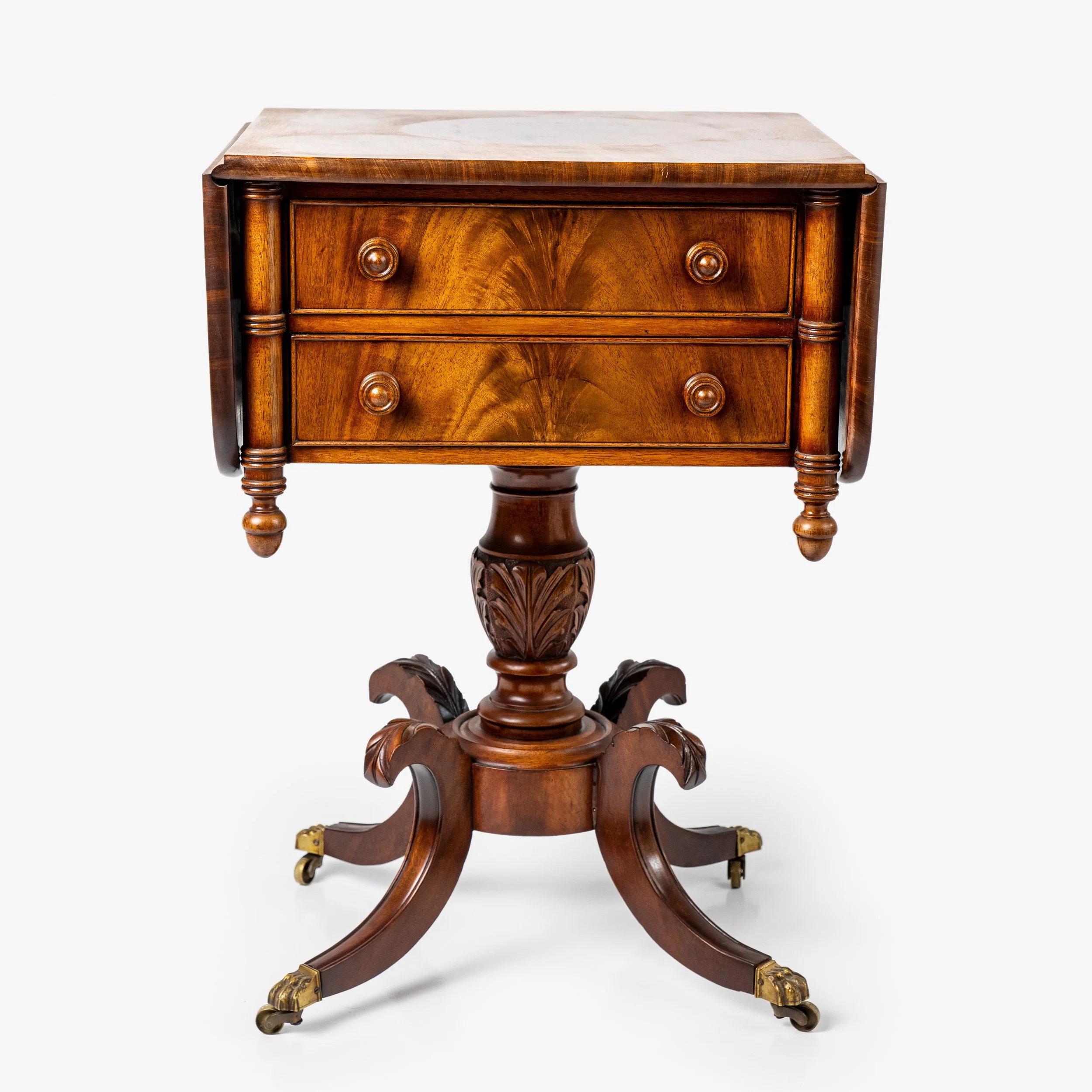
Lot 118: A Mahogany Two-Drawer Drop-Leaf Work Table in the Federal/Empire Taste, Attributed to Alban Emery, Saint John, New Brunswick
What to look for in an Emery piece
Emery was a custom maker. Any design, any style, any wood, any finish, any size — the order book accommodated whatever the client asked. Alban drew the major patterns to scale, often full-size, on brown wrapping paper. The order was entered in a notebook with description and dimensions. In 1974 the New Brunswick Museum acquired more than 800 of those working plans and notebooks.
There are three features distinguish Emery work:
The first is period fluency. He could produce a Queen Anne side chair, a Chippendale ball-and-claw dining chair, a Sheraton-influenced shield-back, and a Regency sideboard with equal skill, because he had studied — and in many cases worked from — the eighteenth-century pattern books that defined those forms.
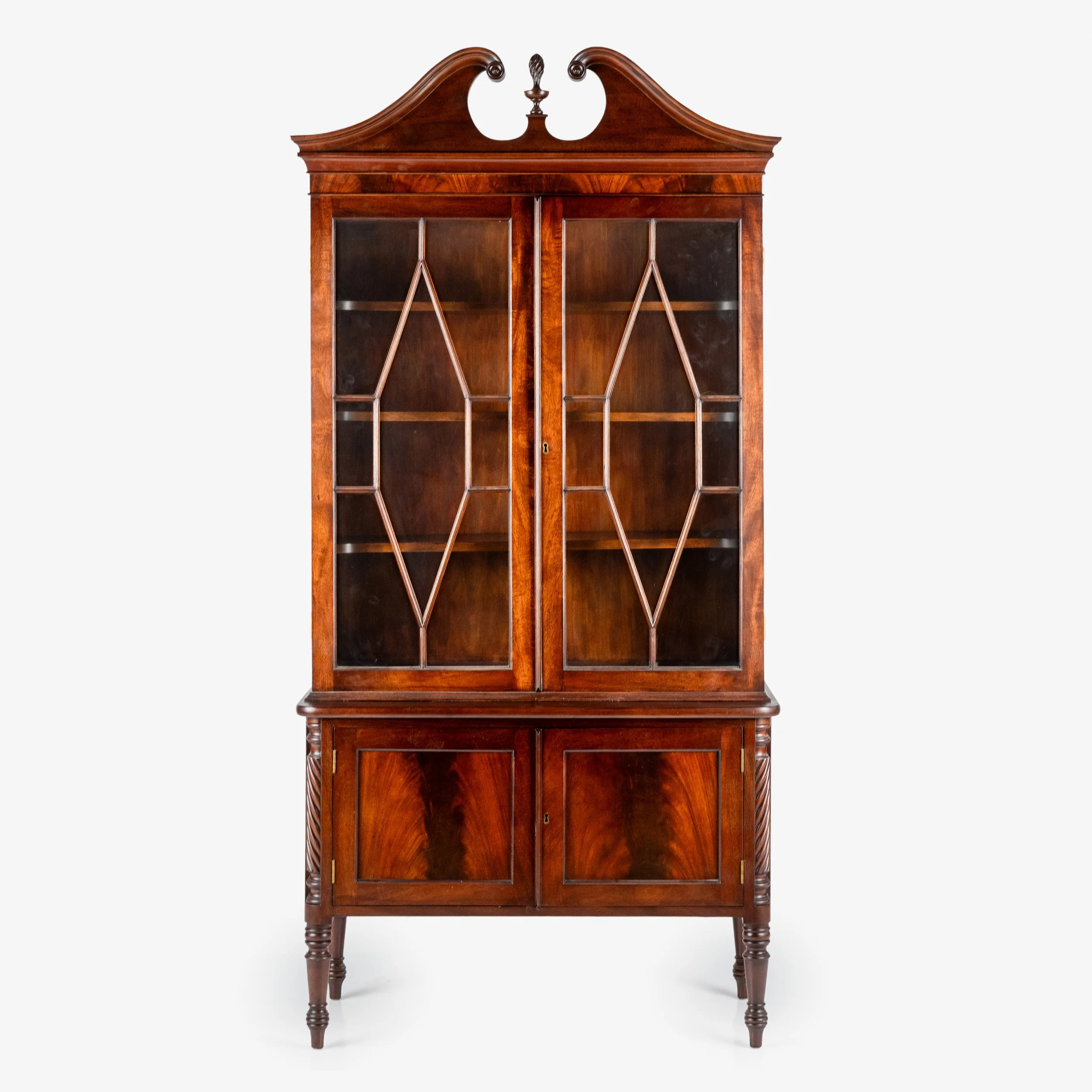
Lot 189: A Mahogany Bookcase in the Sheraton Taste, by Alban Emery, Saint John, New Brunswick
The second is materials discipline. Mahogany is the primary wood in nearly every important piece, with pine, fir, or birch used appropriately as secondary woods; the choices are correct to period and consistent across decades of production.
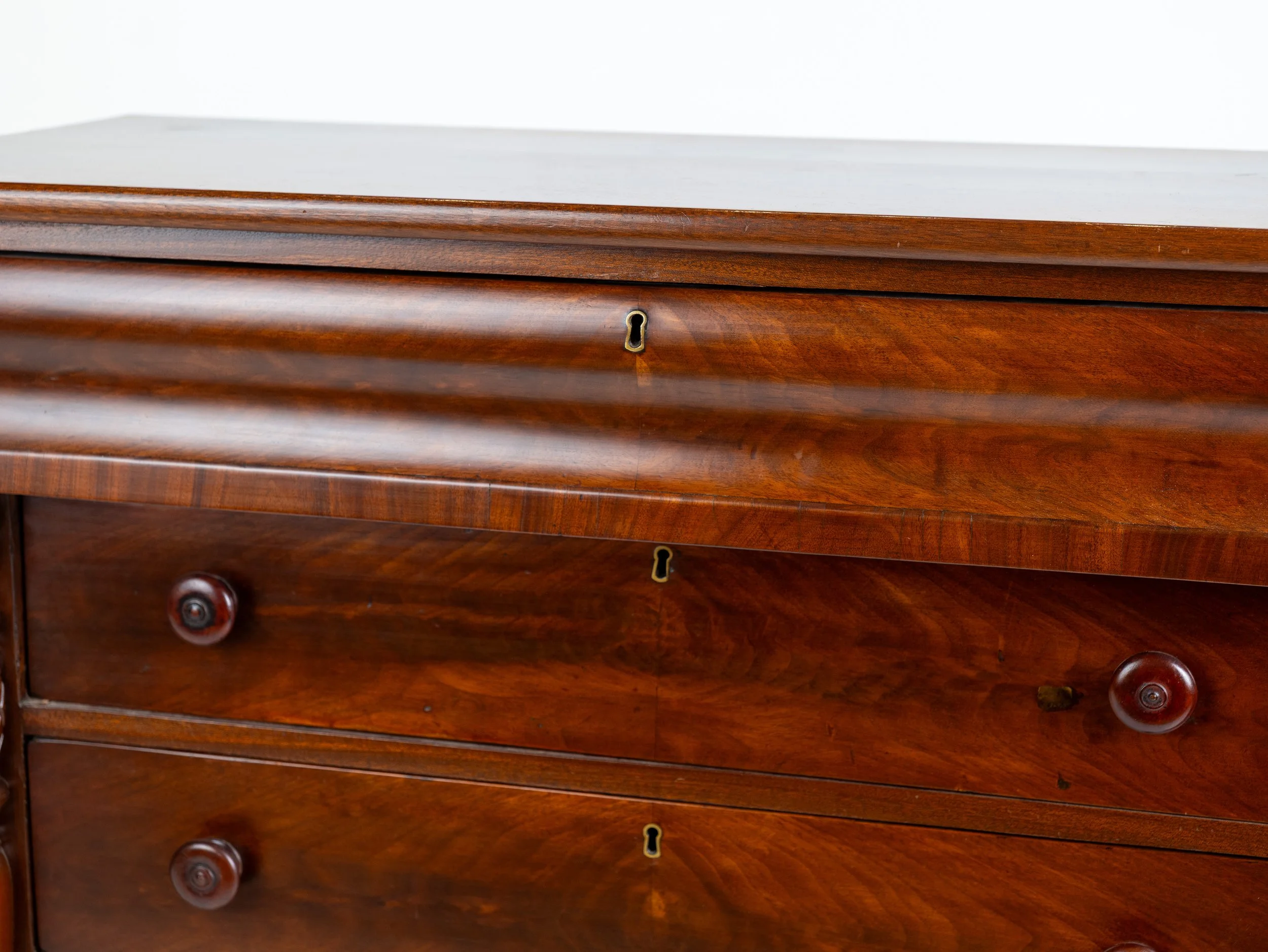
Lot 187: A Mahogany Pillow-Front Chest of Drawers in the Late Classical Taste, Attributed to Alban Emery, Saint John, New Brunswick (detail)
The third is carving. Emery's cabriole knees, ball-and-claw feet, acanthus leaves, lion's paws, pineapple finials, and fan inlays are unhurried and exact.
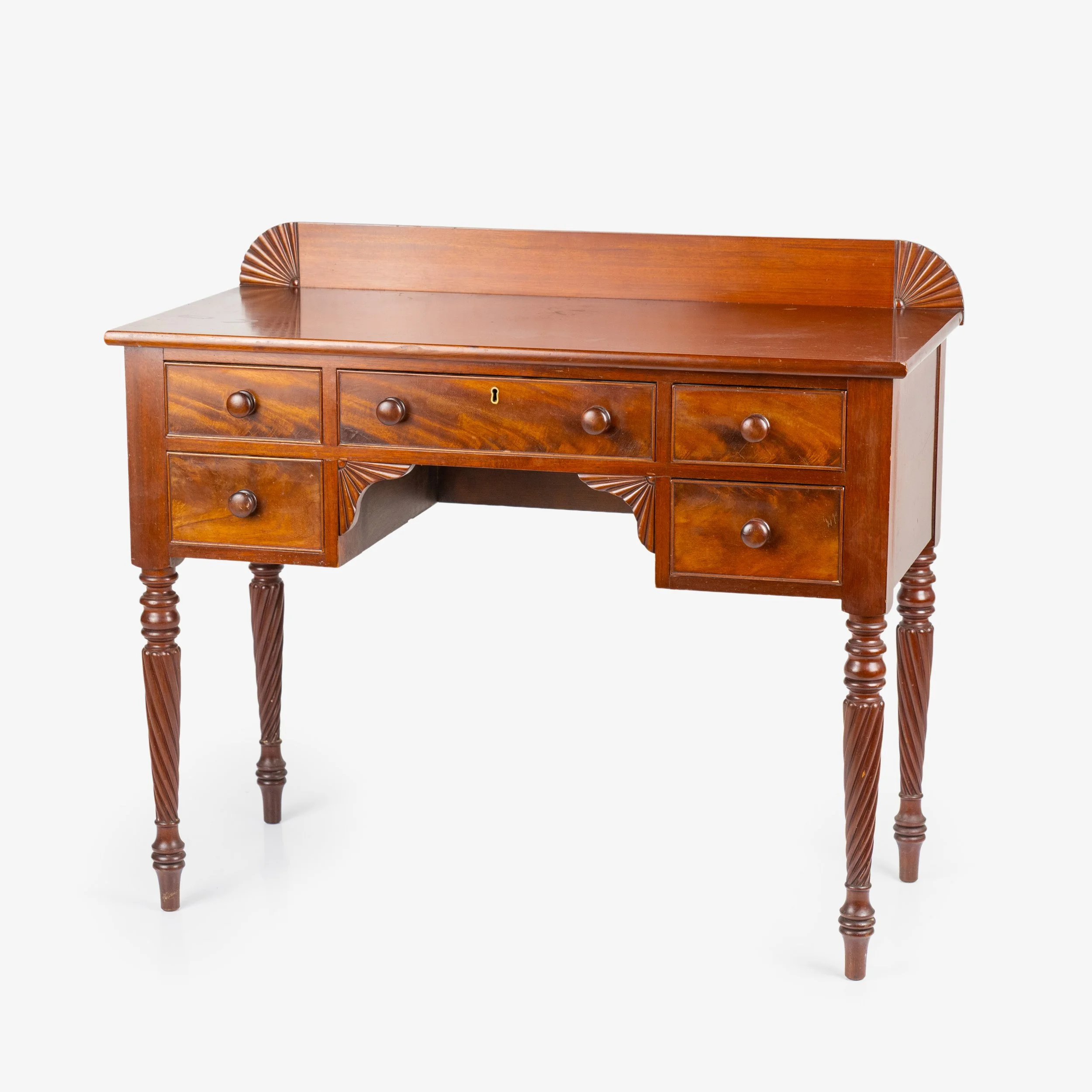
Lot 117: A Sheraton-Style Mahogany Kneehole Desk, Attributed to Alban Emery, Saint John, New Brunswick
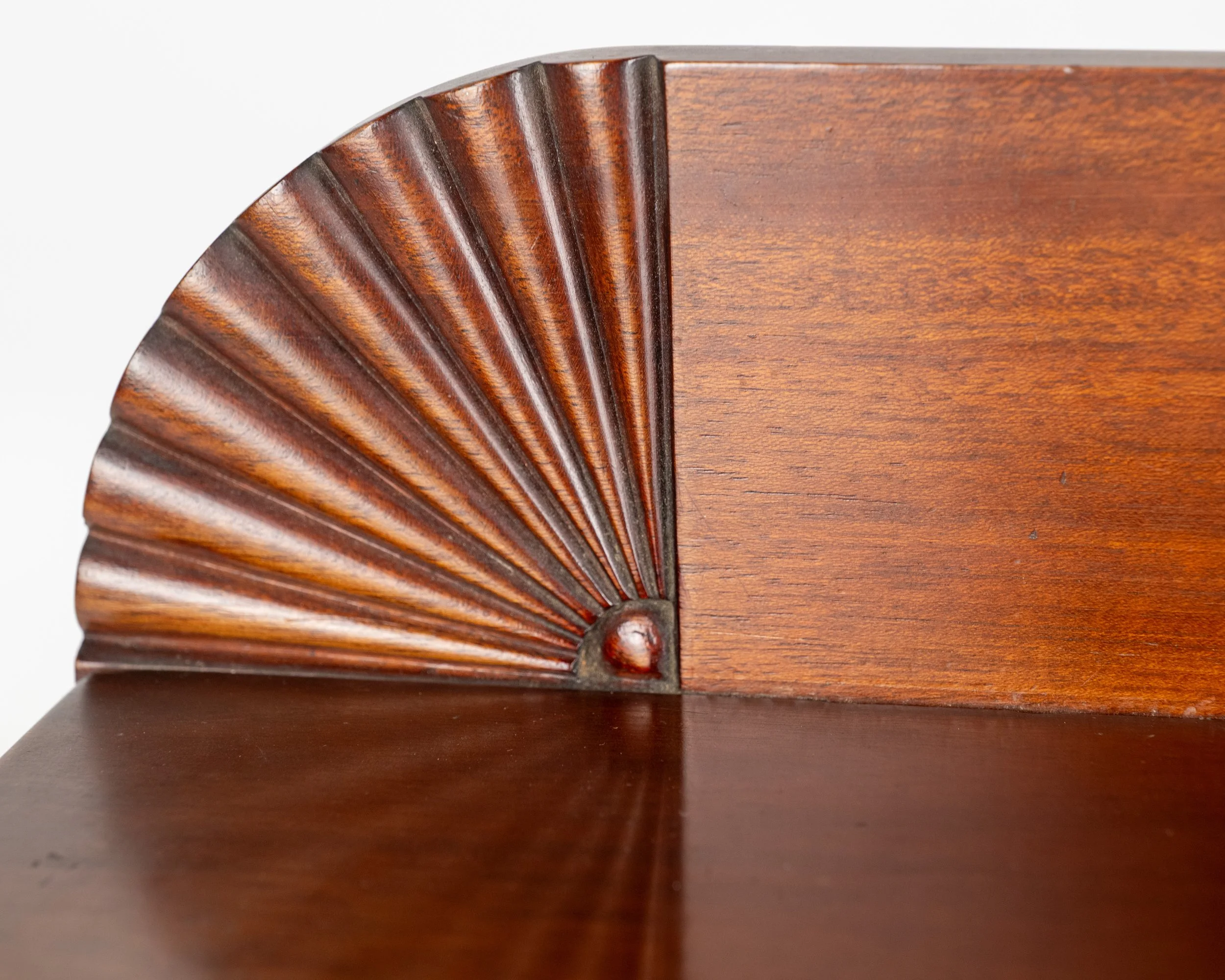
Lot 117: A Sheraton-Style Mahogany Kneehole Desk, Attributed to Alban Emery, Saint John, New Brunswick (detail)
Regarding labels
Emery work is often unmarked. Alban explained the reason to Ryder himself: by the time a piece was ready for shipment, "the main interest in the shop was to get it out of the way to make room for new orders." Labels were applied only occasionally. The corollary is that Emery attribution rests on construction, pattern vocabulary, secondary woods, comparison to the documented body of work in Ryder, Charles Foss's Cabinetmakers of the Eastern Seaboard, and the Dobsons' Heritage Furnishings of Atlantic Canada, and consultation with recognized authorities on the Emery–Claessen cabinetmaking tradition.
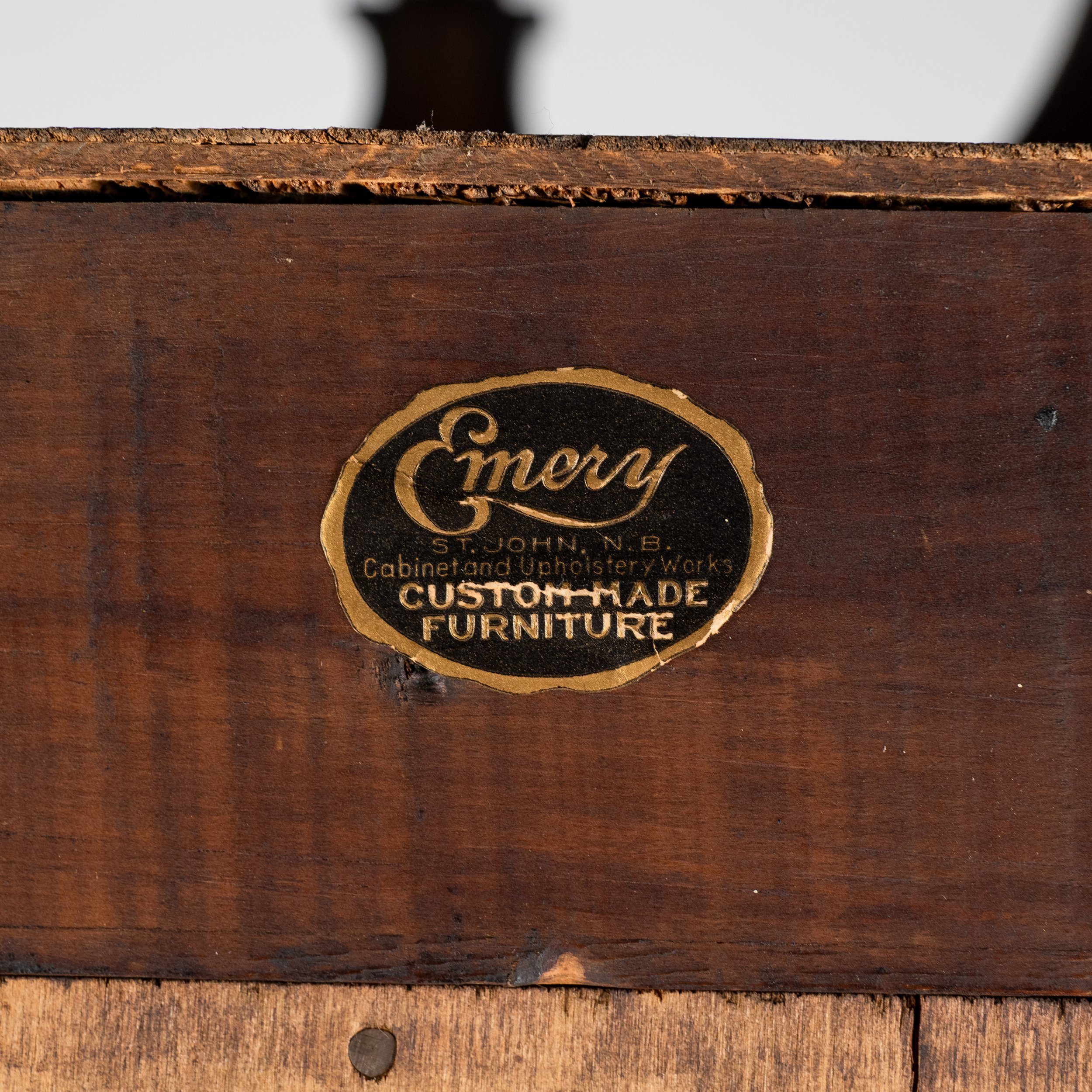
A rare Emery label. (Detail from Lot 189: A Mahogany Bookcase in the Sheraton Taste, by Alban Emery, Saint John, New Brunswick)
The line continues
The group also includes a small number of pieces by Peter Claessen, who began his apprenticeship with Emery in 1951 and carried the Saint John vocabulary forward under his own name through the second half of the twentieth century. A Pembroke table by Claessen, built on spiral-twist turned legs, descends in vocabulary directly from Nisbet's c. 1815–1820 card-table turnings — a piece of furniture in which the workshop continuity of two hundred years is legible in a single leg.
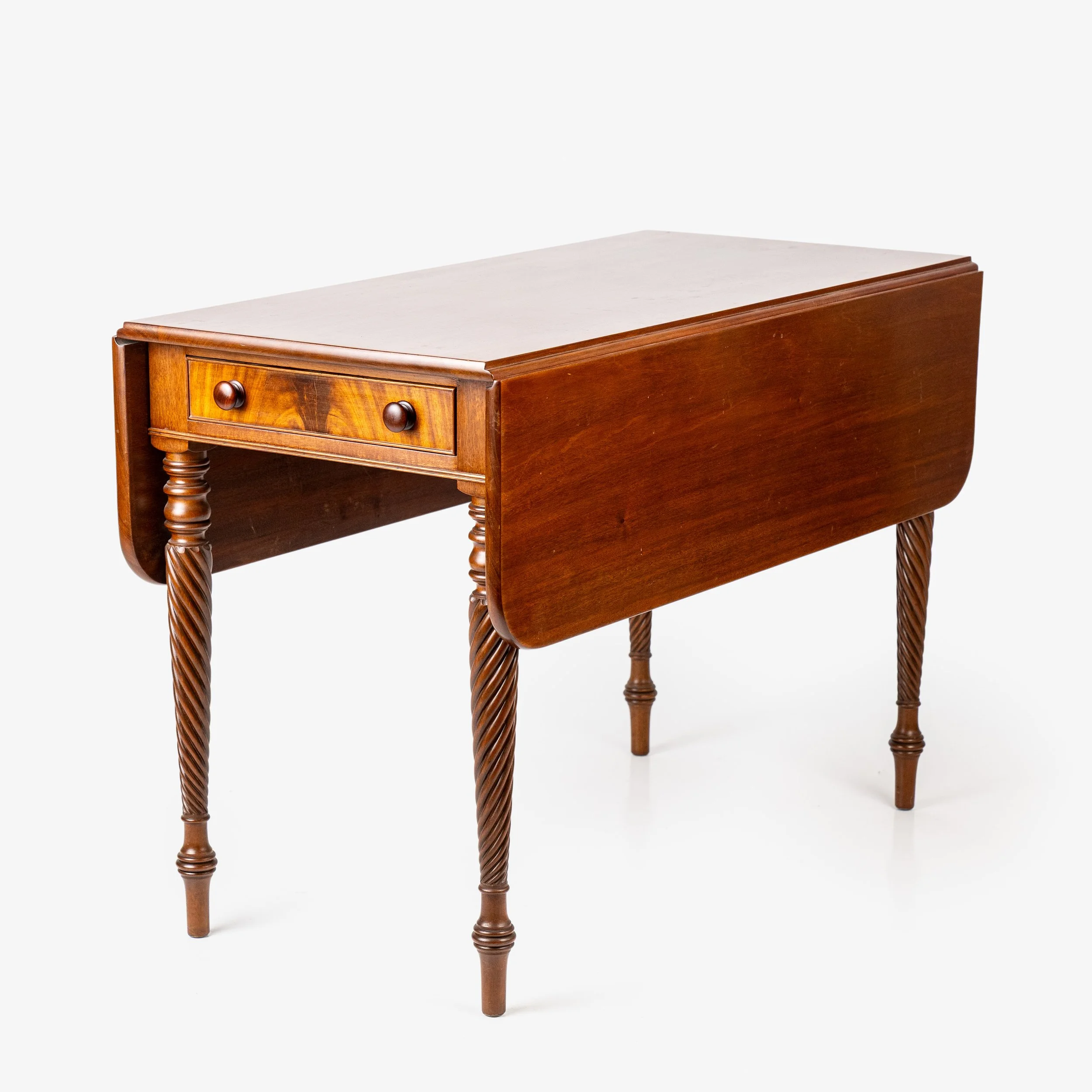
Lot 197: A Mahogany Drop-Leaf Pembroke Table with Spiral-Twist Legs, by Peter Claessen, Saint John, New Brunswick
Full lot details, dimensions, and condition reports follow in the individual catalogue entries. The 2026 Spring Auction opens for bidding on May 24.