
Colville, 1964-1970: Three Serigraphs from the Dow Years
Boat and Marker (1964), Snowplow (1967), and Sunrise (1970) — three works from a foundational decade, all reproduced in Helen J. Dow's monograph
Alex Colville, CC, RCA (Canadian, 1920–2013)
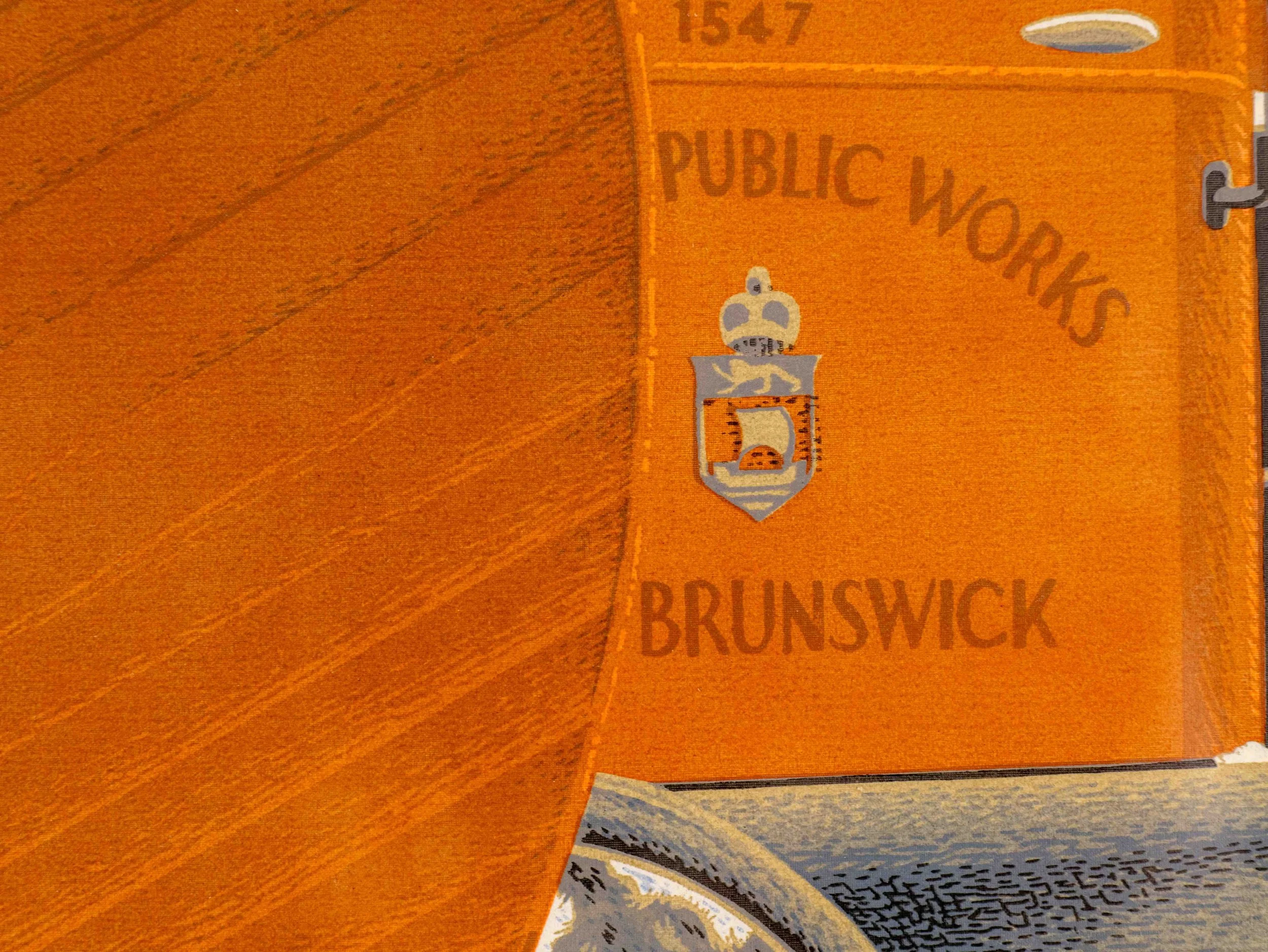
Snowplow (detail), 1967
serigraph on paper, 18/20
23 ½ × 32 in. (59.7 × 81.3 cm)
Offered in the Jones Auction House 2026 Spring Auction.
“In this sense the lettering on the snowplow “Department of Public Works”, “New Brunswick” gives the hint of the theme. It is the biggest print I have done, and perhaps the most complex, in spite of its consisting essentially of only two objects (the Spectator and the Snowplow with driver) in an environment of snow. The colour is quite strong and important.”
Alex Colville resigned his teaching position at Mount Allison University, Sackville, NB, in 1963; he was forty-three years old and had been exhibiting publicly for nearly two decades. The decade that followed — from his transition to full-time studio practice, through his inclusion in the Canadian pavilion at the 33rd Venice Biennale in 1966 (where he showed twelve paintings alongside Yves Gaucher and Sorel Etrog), his visiting artist position at the University of California at Santa Cruz in 1967, and the publication of Helen J. Dow's The Art of Alex Colville in 1972 — was the period of wide professional and critical establishment.
The methodical preparatory drawing; the geometric proportioning system underneath the apparently quiet image; the rear-view figure; the saturated, unresolved/unresolvable psychological charge - these all took working form during this time.
The 2026 Spring Auction presents three serigraphs from this decade: Boat and Marker (1964, edition 13/17), Snowplow (1967, edition 18/20), and Sunrise (1970, edition 57/70). All three are reproduced as plates in Dow's monograph — Boat and Marker as Plate 49, Snowplow as Plate 90, Sunrise as Plate 99 — and the Dow text remains the first book-length scholarly account of the artist, written by a former Mount Allison colleague, with an introduction by Lincoln Kirstein.
Working Method
Colville produced a limited number of major works in any given year, each built outward from a preparatory drawing and an internal geometric proportioning system — most often a root-five rectangle, occasionally the golden section, with the picture's principal forms locked to its lines of division. Each composition is structurally reasoned.
Boat and Marker (1964)

Alex Colville, CC, RCA (Canadian, 1920–2013)
Boat and Marker, 1964
serigraph on paper, 13/17
19 ¼ × 19 in. (48.9 × 48.3 cm)
Literature: Michael Bell, Colville: Being Seen — The Serigraphs, Ottawa: Carleton University Art Gallery, 1994, page 33, reproduced; Helen J. Dow, The Art of Alex Colville, Toronto: McGraw-Hill Ryerson, 1972, Plate 49, p. 121, reproduced; discussed pp. 122, 149.
Dow describes Boat and Marker as "a miraculously subtle serigraph done at the end of 1964," depicting "the Ulyssean image of a sailboat breezing 'past the headlands, into deep eternity,'" and reads Colville's sea as a symbol of infinity in a long tradition of Western philosophical and literary uses of the same image.
The marker pole, set against the small distant sailboat within the circle of the tondo, supplies the single measurable point of scale that the open horizon would otherwise deny the eye. The composition gathers narrative, ornament, and metaphor into a tightly disciplined circular field. The print is signed and dated, numbered 13/17, with the verso label of Manuge Galleries Limited, Halifax.
Snowplow (1967)
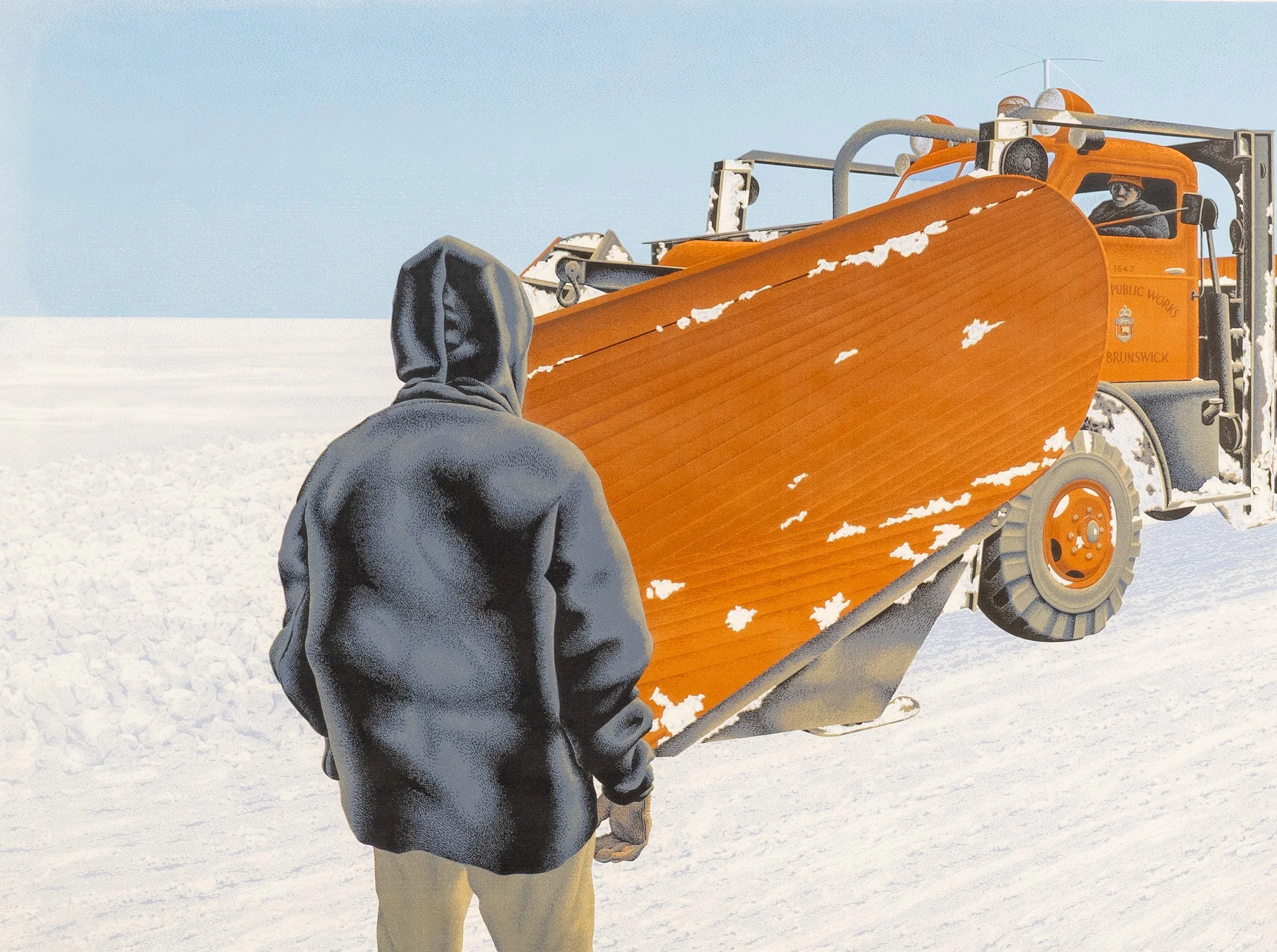
Alex Colville, CC, RCA (Canadian, 1920–2013)
Snowplow, 1967
serigraph on paper, 18/20
23 ½ × 32 in. (59.7 × 81.3 cm)
Literature: Helen J. Dow, The Art of Alex Colville, Toronto: McGraw-Hill Ryerson, 1972, p. 113, discussed; Plate 90, p. 186, reproduced; Michael Bell, Colville: Being Seen — The Serigraphs, Ottawa: Carleton University Art Gallery, 1994.
“In a way the driver of the Snowplow is my friend Charles Forsyth, the United Church minister who is now assistant to the Premier of New Brunswick, or also he is Strelnikov in Pasternak’s Dr. Zhivago — in his armoured train.”
Snowplow translates the same compositional logic to a winter landscape. A hooded figure in a heavy coat stands with his back to the viewer, facing a snowplow that has stopped short of him; the plough-blade dominates the right two-thirds of the image, with the New Brunswick Public Works logo and the operator's face just visible through the cab window. Colville himself, quoted by Dow, described it as "the biggest print I have done, and perhaps the most complex" — composed of essentially only two elements, the spectator and the snowplow, in an environment of snow, with the lettering on the truck door (Department of Public Works · New Brunswick) supplying, in his words, the hint of the theme.
The reading is open — encounter, work interrupted, a meeting on a back road in late winter — but the formal organisation is exact: the figure's silhouette against the blank snow, the diagonal of the blade cutting the image, the operator's face as the single point of focused human presence inside the otherwise mechanical mass of the truck.
Sunrise (1970)
Alex Colville, CC, RCA (Canadian, 1920–2013)
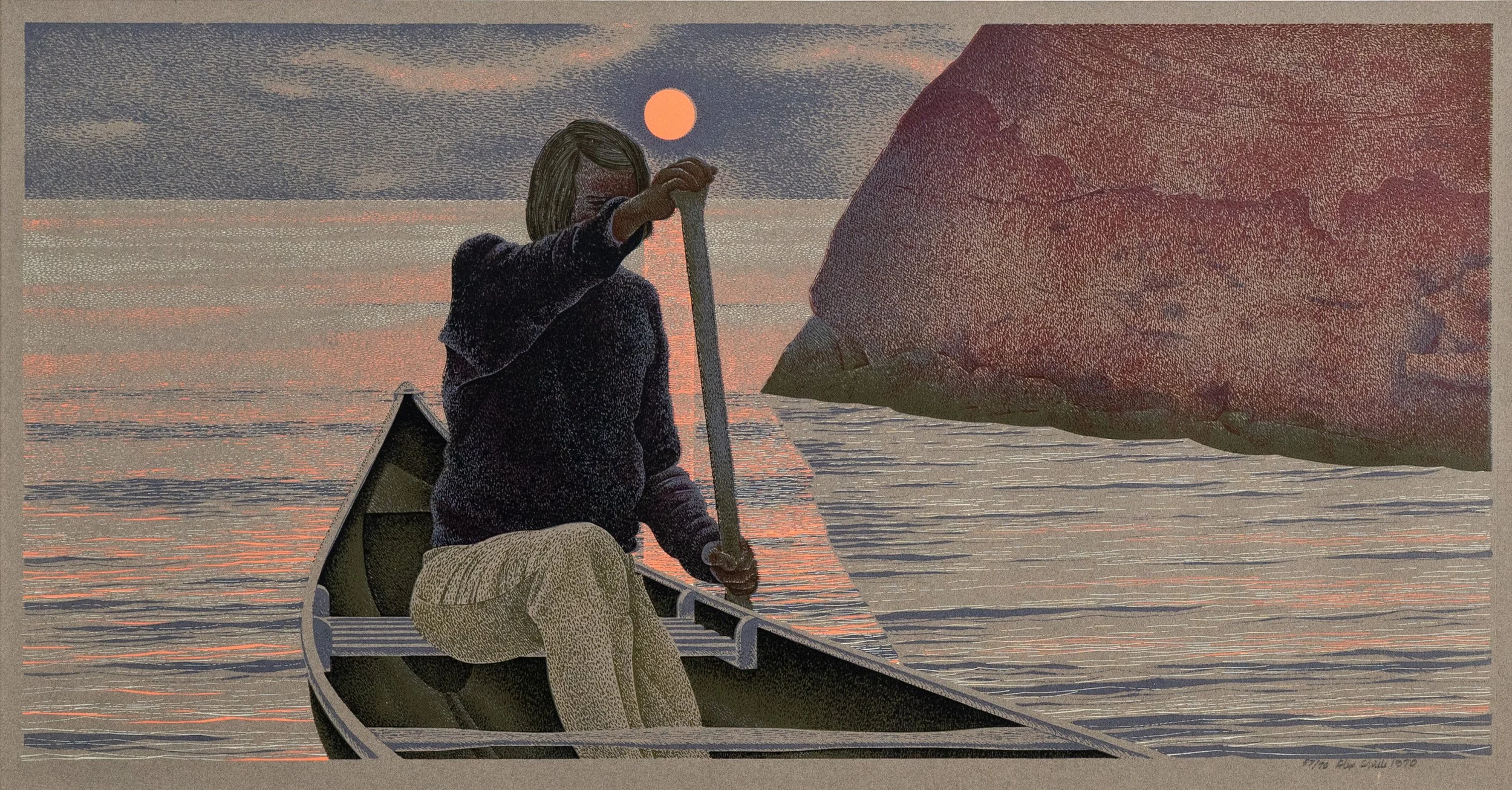
Sunrise, 1970
serigraph on paper, 57/70
23 ½ × 32 in. (59.7 × 81.3 cm)
Literature: Michael Bell, Colville: Being Seen — The Serigraphs, Ottawa: Carleton University Art Gallery, 1994, page 40, catalogue no. 12, reproduced; David Burnett, Colville – Prints/Estampes, Ottawa: Department of External Affairs, Arts Promotion Division, 1985, page 10, reproduced.; Helen J. Dow, The Art of Alex Colville, Toronto: McGraw-Hill Ryerson, 1972, pages 87 and 195, Plate 99, reproduced in colour.
This 1970 colour serigraph from an edition of seventy depicts a woman in a canoe at sunrise. Dow reads the composition as a meditation on the nature of art, love, and marriage:
“The print portrays a woman silhouetted in purplish tones against the glowing rays of a coral sun as she glides mysteriously past a dark embankment in the graceful embrace of a canoe. […] For just as the sun rises uninvited in the sense that it appears without human control, so love, as the reverse of art, happens suddenly and without conscious effort. To Colville, the mystery of love is a sheer gift, while, conversely, marriage in itself is an art, that is to say something premeditated and intentionally planned.”
Sunrise belongs to the larger standard edition of seventy that became the norm for Colville's later prints.
Critical Attention, 1964–1972
The years these prints span coincide with the consolidation of Colville's reputation outside Canada. The Venice Biennale appearance in 1966 was followed by his Santa Cruz residency in 1967, the year he also designed the Canadian Centennial coin set (rock dove, rabbit, mackerel, lynx, wolf, and goose) and was appointed Officer of the Order of Canada. Work from the period subsequently entered the collections of the Museum of Modern Art, New York; the Musée national d'art moderne — Centre Pompidou, Paris; and the Neue Nationalgalerie, Berlin. Dow's 1972 monograph — the first attempt at a sustained scholarly account of the work — would be followed in 1983 by David Burnett's Colville, the catalogue of the Art Gallery of Ontario's internationally touring retrospective, and in 1994 by Michael Bell's Colville, Being Seen: The Serigraphs (Carleton University Art Gallery), the catalogue raisonné of the serigraph practice. Boat and Marker and Sunrise are catalogued in Bell as well as in Dow.
Edition Scarcity and Significance
Of the three, Boat and Marker is the rarest by edition: seventeen impressions is among the smallest runs Colville ever produced. Snowplow follows with an edition of twenty, also exceptional for the period. Sunrise belongs to the standard edition of seventy that became the norm for Colville's later prints.
References
Helen J. Dow, The Art of Alex Colville, Toronto: McGraw-Hill Ryerson, 1972. Introduction by Lincoln Kirstein.
David Burnett, Colville, Toronto: Art Gallery of Ontario / McClelland & Stewart, 1983.
Michael Bell, Colville, Being Seen: The Serigraphs, Ottawa: Carleton University Art Gallery, 1994.